TL;DR
Your quarterly portco summary tells you revenue landed short. It can't tell you which portcos are carrying late-stage deals with no economic buyer attached, because nobody asked that question in a form four different CRMs could answer. Private equity portfolio revenue analytics earns its keep when a firm operator can ask a cross-portfolio commercial question and trust the denominator under the answer.
Here's what you'll learn in this article:
- How one cross-portfolio question breaks into portco scope, stage mapping, contact relationships, typed fields and permission checks
- Why a common revenue model makes the question answerable while each portco keeps its own CRM workspace
- How coverage counts, freshness and comparable denominators separate a usable answer from a confident-looking wrong one
- Where CRM signals fit beside portfolio monitoring, and when this kind of layer is the wrong purchase
Private equity portfolio revenue analytics starts where the portco summary stops
You can see that a portco missed plan. You can't see which deals were never going to close, and you find out a quarter late.
Private equity portfolio revenue analytics is the practice of asking commercial questions across portfolio companies (about pipeline, buyers and deal motion) and getting answers comparable enough to act on. It sits beside portfolio monitoring, which is the collection and review of company-reported financials, KPIs, budgets and actuals. Allvue, Carta, Standard Metrics and Chronograph show up first when operators search this topic, and they're built for the monitoring job: revenue and EBITDA tracking, KPI collection, consolidated dashboards and LP reporting.
Monitoring answers what happened. Commercial revenue intelligence answers what is happening inside the pipeline that produced it. Different question, different data, different plumbing.
Here is the question that exposes the gap. An operating partner walks into a Monday portfolio review and asks: which portcos have late-stage opportunities with no economic buyer identified, or no dated next step? Every portfolio company has the raw material in its CRM. No summary deck has the answer, because the deck was assembled to report results, not to inspect deals.
Without a shared layer, that question becomes an email to five CFOs or RevOps leads, a week of spreadsheet assembly, and five answers built on five definitions of "late stage." By the time they come back, the deals in question have moved.
A portfolio question is only as good as the worst-defined CRM it touches.
One portfolio question breaks into five checks before it returns a trustworthy answer
Skip the decomposition and you get a number. You don't get an answer you can take into a board conversation.
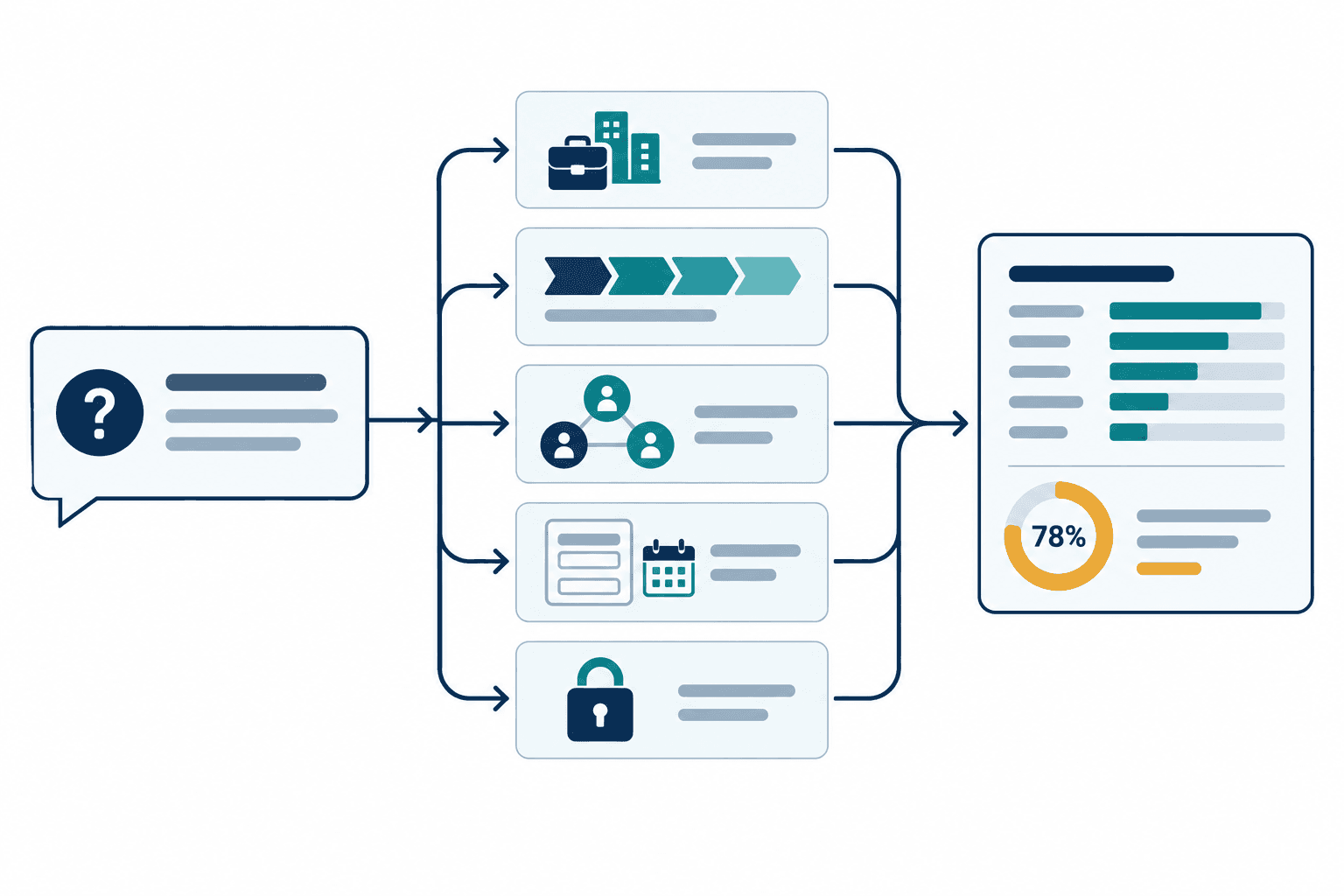
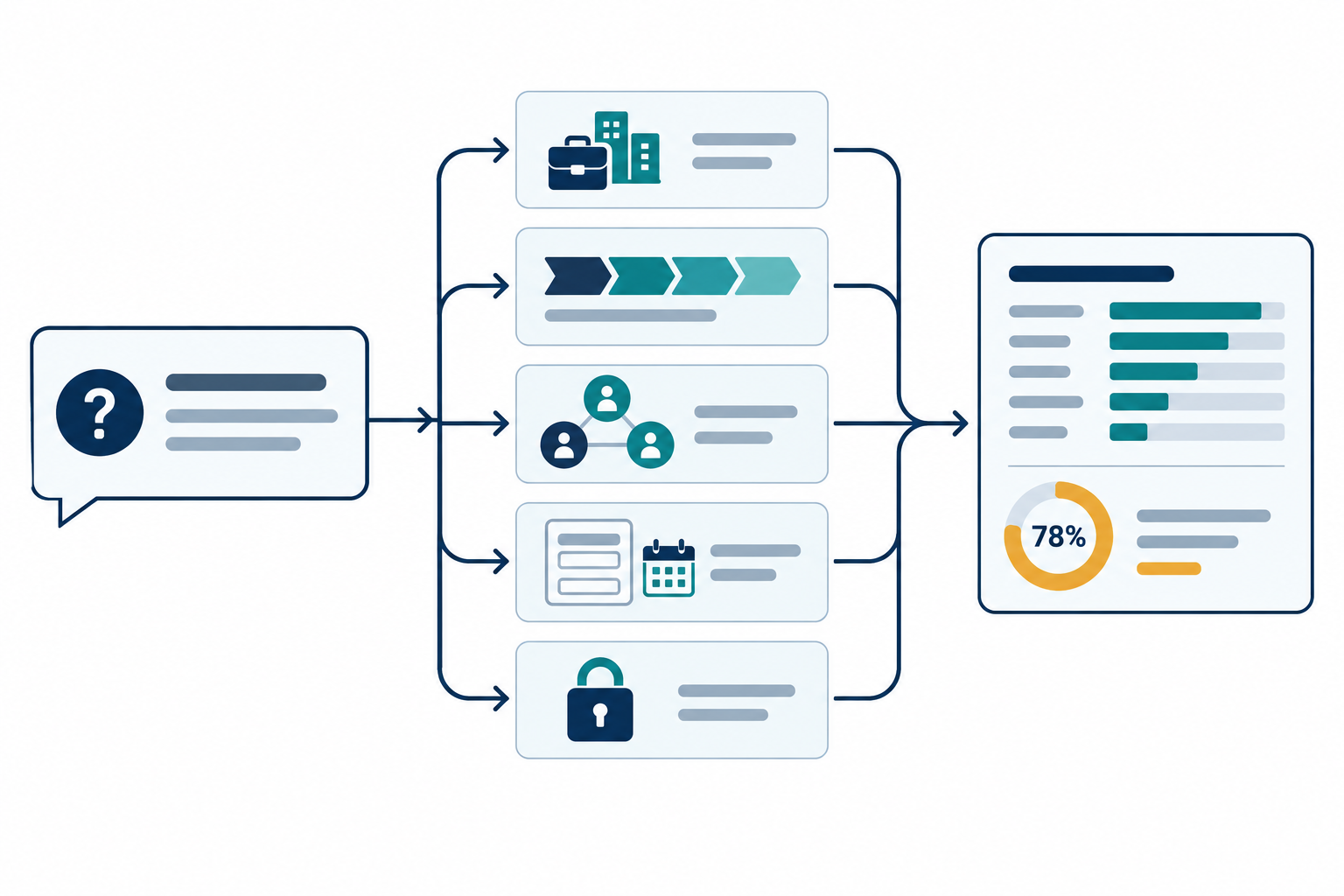
A cross-portfolio query is a question that has to resolve the same way in every portco's data, even though every portco built its CRM differently. The economic-buyer question looks like one ask. It is five. What follows is how we'd break it down. Treat it as a proposed query pattern, the way we think a firm operator should frame the ask, and not as a transcript of a product demo.
Portco scope decides which companies count
Start by stating which portcos are in the question. A platform company and two recent add-ons might still run separate CRMs. A carve-out might have six months of history. Excluding a portco is fine. Excluding it silently is how you end up comparing four companies while the slide says five.
Stage definitions need a written mapping before "late stage" means anything
"Late stage" at one portco is Negotiation. At another it's Stage 4 of 7, and at a third it's a custom picklist value someone named "Verbal" years ago. A normalized stage definition is a mapping from each company's stage values to a shared set of buckets, with the mapping written down where an analyst can read it. If you can't read the mapping, you can't defend the answer.
Contact relationships carry the economic buyer, or fail to
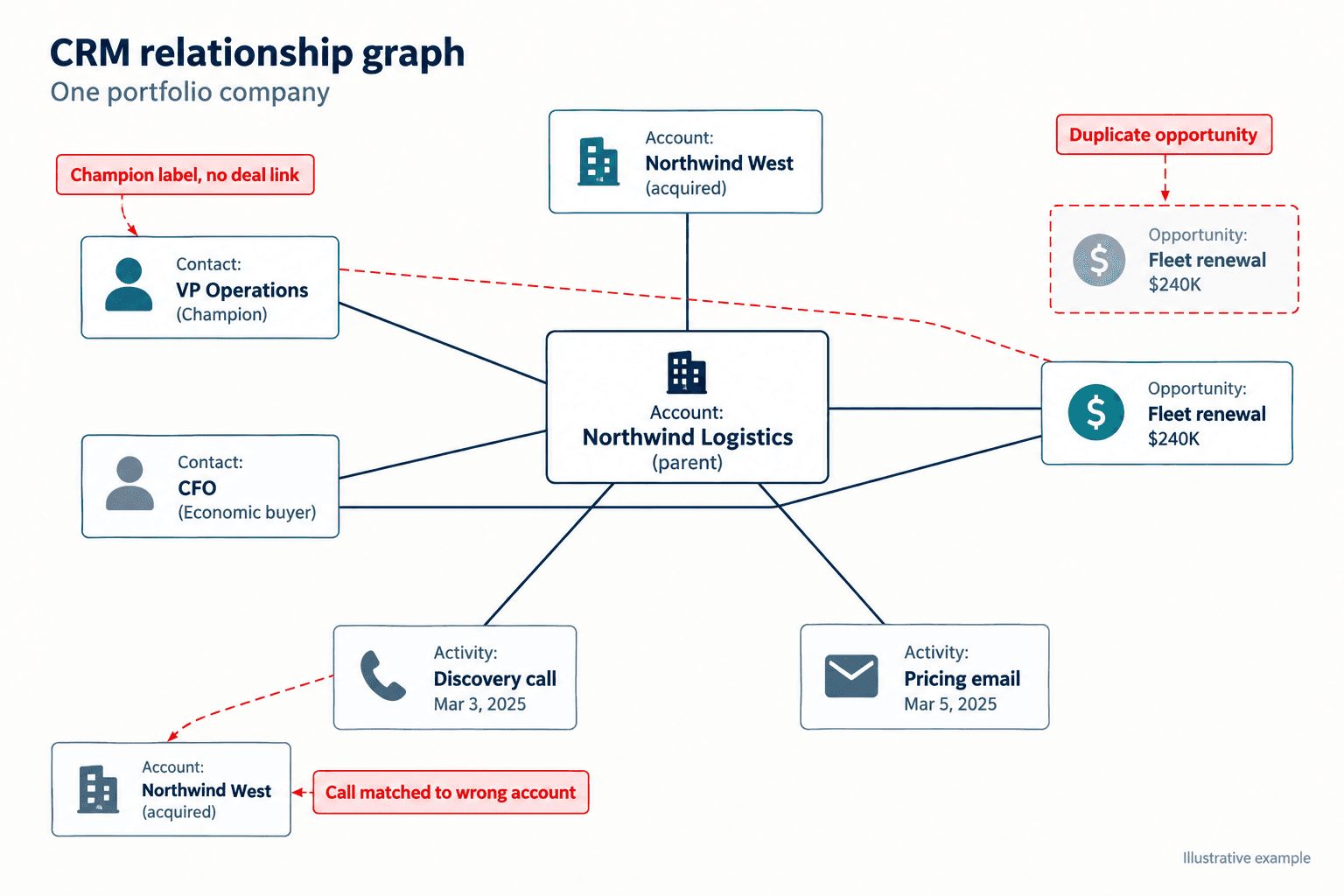
An economic buyer is rarely a field on the opportunity. It's a relationship: a contact linked to the deal with a role. One portco uses contact roles, another logs the CFO's name in a notes field, a third keeps it in a rep's head. The query has to know which method each portco uses, and it has to count the deals where no relationship exists at all.
Typed fields keep "next step" from being free text
"Dated next step" requires a date. Plenty of CRMs hold next steps as text, something like "follow up after board mtg." A typed field is a field with a declared data type (date, currency, picklist), so the system can test it. Free text can be read but not filtered reliably, and that difference changes the result.
Permission checks decide who sees what
A firm analyst asking about deal-level contacts at a portco is crossing a boundary. Who at the firm sees opportunity detail versus rollups is a governance decision each firm makes with its portcos. Put the permission check in the query design, before someone forwards the wrong spreadsheet.
A common revenue model makes the question possible across different CRMs
Your portcos will not standardize on one CRM for your convenience, and forcing them to is a fight that costs more than the visibility is worth.
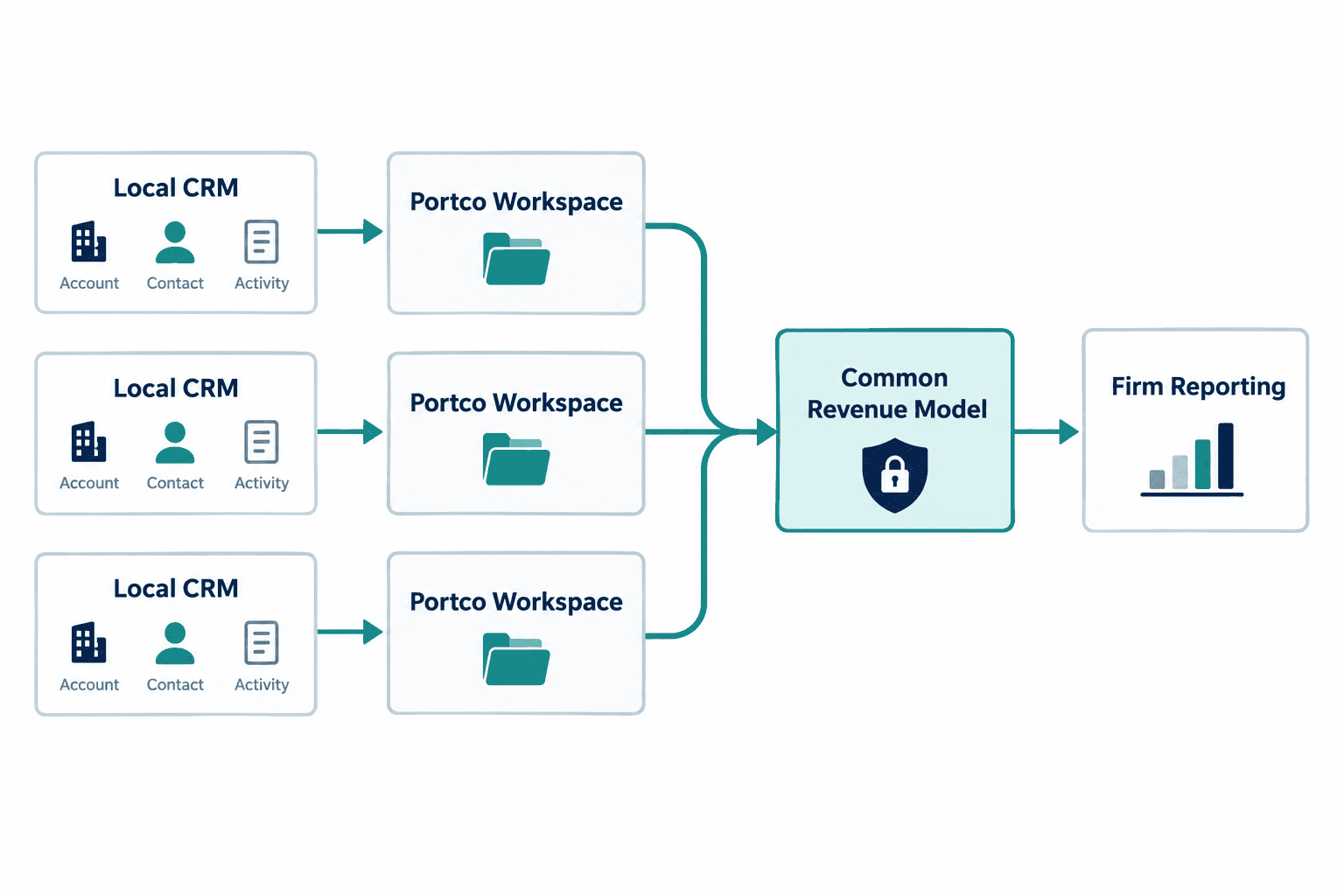
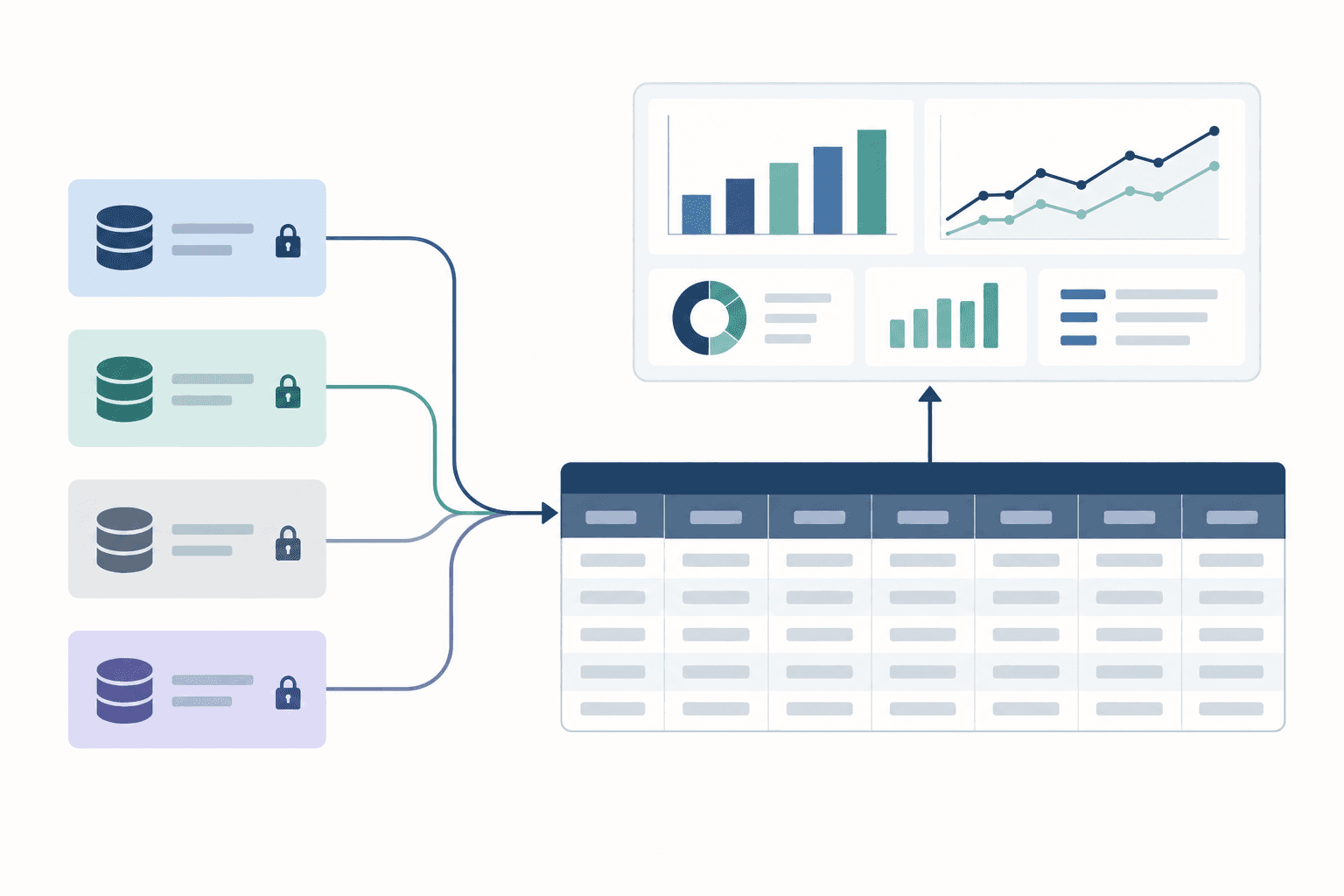
A common revenue model is a shared definition of accounts, opportunities, contacts, stages and activities that every portco's data maps into, regardless of which CRM it lives in. With that model in place, the economic-buyer question gets written once and runs across the portfolio. Without it, five people rewrite it five times and get five slightly different answers.
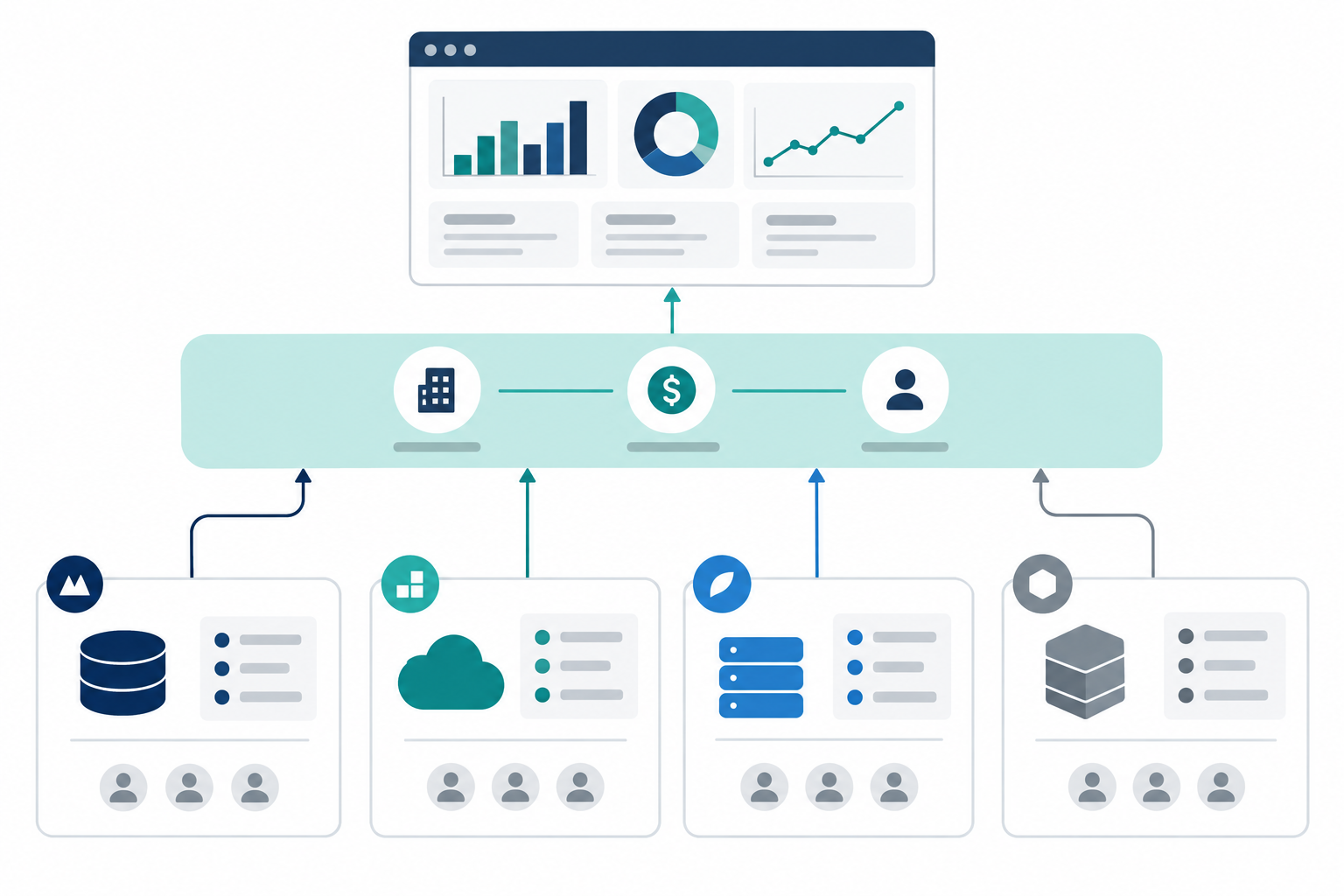
GenieCRM, GTM Engine's offering for private equity firms, is built on that design. It sits on top of each portfolio company's existing CRM, maps its revenue data into a shared model, and gives the firm a portfolio-level view while each portco keeps its own workspace for daily work. Nobody migrates CRMs. A portco's sales team keeps its stages, fields and habits, and the mapping does the translating.
That matters more than it sounds. One buyer we spoke with described acquisitions that were supposed to integrate and never did, leaving what they called "five separate companies in one." That was a single company, not a fund. Multiply it across a portfolio and translating beats forcing by a wide margin.
Coverage counts and comparable denominators decide whether the answer is usable
A confident portfolio number built on half the data is worse than no number, because people act on it.
Every cross-portfolio answer needs to carry its own receipts. Before anyone acts on the economic-buyer result, we'd want four things attached: the source records behind each count, how fresh those records are, what the query couldn't determine, and how many deals lacked the relationship it was looking for.
The table below is an illustrative example. The portcos and numbers are invented to show the mechanics, not drawn from customer data.
| Portco (illustrative) | Late-stage deals | Economic buyer linked | Buyer missing | Unknown (no role data) | Most recent record update |
|---|---|---|---|---|---|
| Portco A | 42 | 30 | 8 | 4 | 2 hours ago |
| Portco B | 11 | 3 | 2 | 6 | 9 days ago |
| Portco C | 67 | 41 | 22 | 4 | 1 day ago |
| Portco D | 19 | 0 | 0 | 19 | Contact roles not used |
Read Portco B first. On a raw count it has the fewest missing buyers, two. On coverage, more than half its late-stage deals are unknown, and the data is nine days old. Portco D has no relationship data at all. A summary ranking portcos on "deals missing an economic buyer" would put B and D at the top of the healthy list. They belong at the top of the go-ask list.
Comparable denominators mean dividing by the right base. Portco C has 22 missing buyers out of 67 late-stage deals; Portco A has 8 of 42. As rates, that's 33% against 19%. The comparison only holds if "late stage" was mapped the same way at both, which sends you straight back to the stage mapping.

Report unknowns as their own column. The moment they get folded into "missing" or "present," the answer starts lying.
Source review is the last check. An analyst should be able to click from "22 missing" at Portco C to the 22 opportunities and see why each one counted. If an answer can't be traced to records, it's an opinion with a chart attached.
CRM signals complement portfolio monitoring and never replace it
Pipeline data tells you where to look. It can't tell you why revenue moved, and pretending otherwise gets operators burned.
CRM signals are inputs for inquiry. Your portfolio monitoring stack still owns reported revenue, EBITDA, budget versus actual and LP reporting. When a monitoring platform shows a portco behind plan, commercial data adds the next layer: whether late-stage deals are thin on buyers, whether next-step discipline has slipped, whether one product line is carrying the rest.
That last one deserves attention. One operator we spoke with described four product lines, with "two where we're just hemorrhaging money." At the top line, that company reports one revenue number heading one direction. It's one anecdote and not a portfolio pattern, but it shows how a rolled-up figure hides the variation an operator needs to see.
Reconcile before you decide. A CRM signal that conflicts with company financials is a reason to call the portco's CRO, not a reason to rewrite the forecast. Data quality, definitions and sales process differ by company, and the coverage columns above exist to expose exactly those differences.
A good answer decides where operating support goes next
Your operating team has finite hours. A portfolio question should end with a ranked list of who gets them.
The economic-buyer question exists to prioritize. A portco with high coverage and a high missing-buyer rate has a deal qualification problem, which calls for a sales-methodology engagement. A portco with low coverage has a data problem first, and sending a qualification coach there is premature. A portco with stale records needs a conversation about CRM habits before anyone trusts its pipeline.
Those three diagnoses send different people. Running the same question the same way across the portfolio sorts portcos into different kinds of help, which a summary deck can't do. GenieCRM's positioning ties this work to the revenue unit economics operators already track (opportunity volume, win rate, average deal size and sales-cycle length) and to firm-level plays that roll down to portcos. Whether a specific play moves those numbers at a specific portco is something you measure afterward, not something to assume going in.
What GenieCRM is built to do, and what this article only proposes
Several vendors will pitch you portfolio intelligence. Ask each one to separate what's running in production from what's on a slide.
Here's our version. GenieCRM is designed as an intelligence layer over existing portco CRMs, with a common revenue model, a firm-level view and a separate workspace for each portfolio company. Analysts and operating partners get self-service access to portco revenue data, so a follow-up question doesn't turn into an email thread with a CFO.
The query decomposition, coverage table and prioritization logic in this article are proposed patterns. They describe how we think a firm operator should ask and audit a cross-portfolio question. Not every GTM Engine capability built for a single company's revenue team carries over to firm level automatically, and portfolio-level permissions and stage mappings get configured per firm and per portco. Ask to see your own question run against your own portcos before you believe any vendor, us included.
This layer is also the wrong buy in some situations. If your portcos lack usable CRM data or won't grant access, a common model has nothing to map. If there's no live decision it will inform, it sits unused; one prospect who liked the concept put it bluntly: "No. Do I have a client for it today? No." And if your operating partners are attached to their current process, adoption is a real cost. Another buyer summed up established operating partners this way: "They just don't want to change." Both are single conversations, not market data, and both are honest reasons to wait.
Ask one question, then audit the answer before you staff against it
Better questions still lose to bad denominators.
The expensive failure in portfolio operations is misallocated help: qualification coaches sent to portcos with data problems, data cleanup funded at portcos with qualification problems. Monitoring tells you which companies missed. A shared commercial model, audited for coverage and freshness, tells you which kind of help each one needs.
Your next step is small. Write down one cross-portfolio question you can't answer from the current summary deck. Then, for each portco, write down which stage counts as late, where the economic buyer lives, whether next step is a date field, and who is allowed to see deal detail. The blanks on that page are your real readiness assessment.
Frequently Asked Questions
How do you perform portfolio analysis across portfolio companies?
Start with company-reported financials and KPIs in your portfolio monitoring system, then add commercial data from each portco's CRM to explain the movement. Define shared terms (stages, buyer roles, date fields) before comparing companies, and report coverage alongside every result.
What is the best private equity portfolio revenue analytics tool?
It depends on the job. Monitoring platforms such as Allvue, Carta, Standard Metrics and Chronograph focus on financial and KPI reporting. PE CRMs such as DealCloud and Affinity support the firm's own deal and relationship work. A commercial layer over portco CRMs, such as GenieCRM, targets pipeline and deal-execution questions. You may need more than one, so choose by the decision each tool has to support.
What KPIs measure revenue across a portfolio?
Reported revenue, growth against plan and budget versus actual come from financials. Commercial KPIs that help explain them include opportunity volume, win rate, average deal size and sales-cycle length. Compare them across portcos only when the underlying definitions match.
Is 30% revenue growth good?
No single threshold holds across a portfolio. Judge growth against the company's plan, prior performance, revenue quality and market. A portco growing 30% against a 45% plan has a different problem from one growing 30% against a 20% plan.
Does a portfolio-level view mean portcos lose control of their CRM?
Not in the GenieCRM design. Each portco keeps its own CRM and its own workspace. The firm sees mapped data through the shared model, with visibility set by permissions the firm and portco agree on.
Bring one cross-portfolio question to a GenieCRM walkthrough. Send the GTM Engine team the question and a list of the CRMs your portcos run, and we'll walk through how the stage mapping, relationship coverage and permission checks would apply to your portfolio.